
Over the summer and start of the school year you were intentional about how you set up your environments, designed and offered materials, and created community. You designed interesting, Compelling Materials that drew children into play. The intentions of Explicit Presentation and Responsive Scaffolding helped you support engagement with the experiences and materials you offered. But did you know you can also apply these intentions to your daily routines?
When you spend time unpacking a routine, whether it’s how to wash hands, or how to put on a jacket to go outside, or set up a rest mat articulating what it looks like and feels like in your classroom helps to set expectations for what children do and forges a connection between routines and self-regulation.
A routine is anything that has a sequence of actions and is a regular/daily procedure. Routines are at the heart of the classroom because they set the stage for creating safe and predictable environments that children can navigate with ease. From the start of the school year, teachers shape children’s experiences, and the classroom community, by creating tools and techniques that function as prompts to answer the questions, “What comes next” and “What should we do?” “How shall we do it? It is important to plan for daily routines and do a mental rehearsal of how they think things will work, adjusting as the year goes on.
Let’s take an example from a real classroom. The children have a story time meeting at 11am. After this meeting the children transition from the potty, to washing hands, to drying hands and then to their lunch spots. That is a lot of necessary small transitions and routines and might sound familiar to you. Teachers often identify this time of day as difficult, noisy, and disorganized. How can we bring ease to these routines?
Teachers paused to reflect on the goals of this time (to be clean and ready for lunch in a smooth and settled way) and observing where the difficulty rests. Do the children really know what to do and have they had an opportunity to see it and practice it? When children have previews, guidance, and explicit presentations on the parts of routines, and time to practice them, they begin to internalize the steps and move through them with independence, confidence, and a sense of calm.
With handwashing in particular, some children are attracted to the sensory aspect of the process. They love the feel of the water and the slipperyness of the soap, and the excitement of pumping a lot of soap or pulling out lots of towels. It is important to offer these sensory experiences in other parts of the classroom – pump bottles, sponges, droppers and water in the sensory table for example. This way you can help children make a distinction between what happens during a routine and a more open-ended outlet for play – and they can learn the difference.
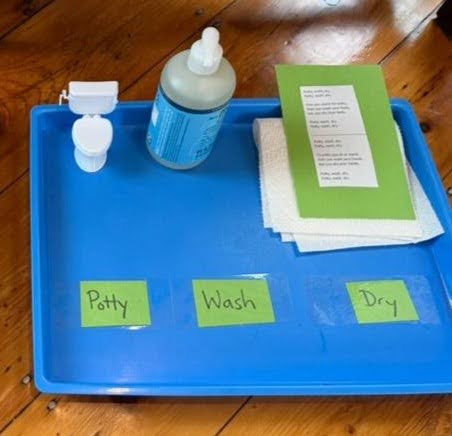
Visual cues such as sequence cards with drawings or photos can prompt children with a reminder of process and steps, but more powerful scaffolding is often needed. The teachers designed an explicit presentation to help their classroom community navigate this class transition. The teachers created a visual tray with engaging objects and the words, “potty, wash, dry” as the mantra. This presentation included a song to the tune of children’s song Three Blind Mice. Can you hear yourself singing “potty, wash, dry” to the tune! Children joyfully watched and listened to the sequence as teachers presented it to small groups of children. Teachers acted out pumping a soap bottle (without soap in it), then using one towel to dry their hands and modeled throwing that towel in the trash can. They introduced another mantra, “one flush, one pump, one towel” to conserve resources and help the group move through a busy transition more efficiently.
We love small group presentations as it is often easier for children to focus. You can also try this with a whole group if they are able to pay attention together.
This representation of the routine combined objects and language that scaffolded children’s experiences. They remember the little toilet, then how to pump the soap saying “one pump” and use the towel – “dry dry”. You could also create a playset in the tradition of Small Worlds, adding little figurines, a small doll house sink, little trash basket, etc. so children can act out the routine during play over and over.
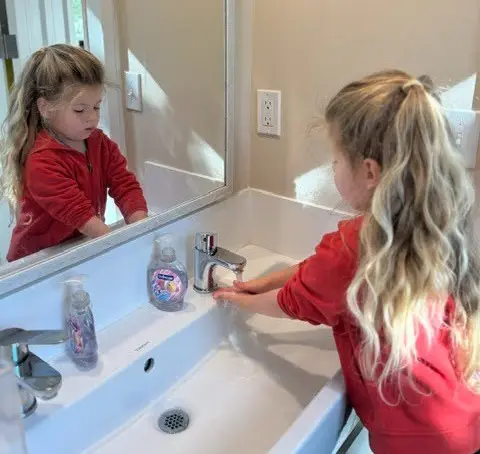
When it was time for children to engage in the actual transition, the teachers thoughtfully staggered children to the restroom, scaffolded the experience by singing the song with them, and were thrilled to see the routine become more fluid and independent!

 Discover practical strategies to foster joyful engagement, access high-quality learning on your schedule, and elevate your teaching practice.